Botpress vs Com.bot for Automating WhatsApp Customer Support in 2026
You need WhatsApp support that answers hundreds of customers without hiring hundreds of agents. The choice between Botpress and Com.bot comes down to how much setup you can tolerate and what you need running on day one.
This comparison covers WhatsApp Business API access, bot building, multi-channel support, payments, bulk messaging, and pricing for both platforms. By the end, you will know exactly which tool fits your support team in 2026.
Quick Verdict: Botpress vs Com.bot for WhatsApp Customer Support in 2026
If you need a WhatsApp-first support stack with native payments and no per-conversation markup, Com.bot wins; if you need deep code-level control and a developer SDK, Botpress is the stronger pick. That single trade-off explains most of the decision.
Com.bot is a ready-to-deploy WhatsApp Business API platform. It pairs an omnichannel inbox with built-in payments and an official Meta Business Partner relationship, so teams can launch customer support automation without building the channel layer themselves.
Botpress is a developer-centric conversational AI framework. It gives engineering teams a code-first environment for custom NLP pipelines, intent recognition, and self-hosted deployments, but connecting it to WhatsApp typically means custom integration work.
For a 2026 comparison, the practical question is not which platform is more powerful in the abstract. It is how much of the WhatsApp channel you want to build, maintain, and pay for yourself.
| Criteria | Com.bot | Botpress |
|---|---|---|
| Best for | Businesses wanting fast WhatsApp support automation with an official Meta partnership | Development teams building custom conversational AI and self-hosted stacks |
| WhatsApp Business API support | Native, as an Official Meta Business Partner | Generally available through custom integration work |
| No-code builder | Yes, with a visual flow builder | Primarily code-first; low-code options exist but are more technical |
| Native payments | Yes, built in | Not a native capability; would require custom development |
| Pricing model | No markup on WhatsApp conversations | Varies by plan and hosting setup; check current vendor terms |
1. Choose Com.bot if you want WhatsApp automation live quickly. The platform combines an official Meta Business Partner status, a no-code builder, native payments, and no markup on WhatsApp conversations, which suits support teams that would rather configure than code.
2. Choose Botpress if your roadmap depends on custom NLP work. Teams that need to own the model layer, tune entity extraction and dialogue management directly, or self-host for infrastructure reasons will find a framework more flexible than a managed platform.
3. Consider a hybrid setup. Some organizations run Botpress for complex conversational flows while routing the WhatsApp channel through Com.bot. This keeps the channel compliant and payment-ready while preserving code-level control where it matters.
Scale is a fair tiebreaker. Com.bot reports 25M+ messages per day processed, 100K+ bots created, and 23,000+ active customers, which speaks to production readiness on the WhatsApp side.
The detailed sections below break down integration, pricing, features, and setup so you can match the verdict to your own team's constraints.
At a glance: how Com.bot compares to Botpress on the features that matter most.
| Feature | Com.bot | Botpress |
|---|---|---|
| WhatsApp Customer Support | ✓ | ✓ |
What Is Com.bot?
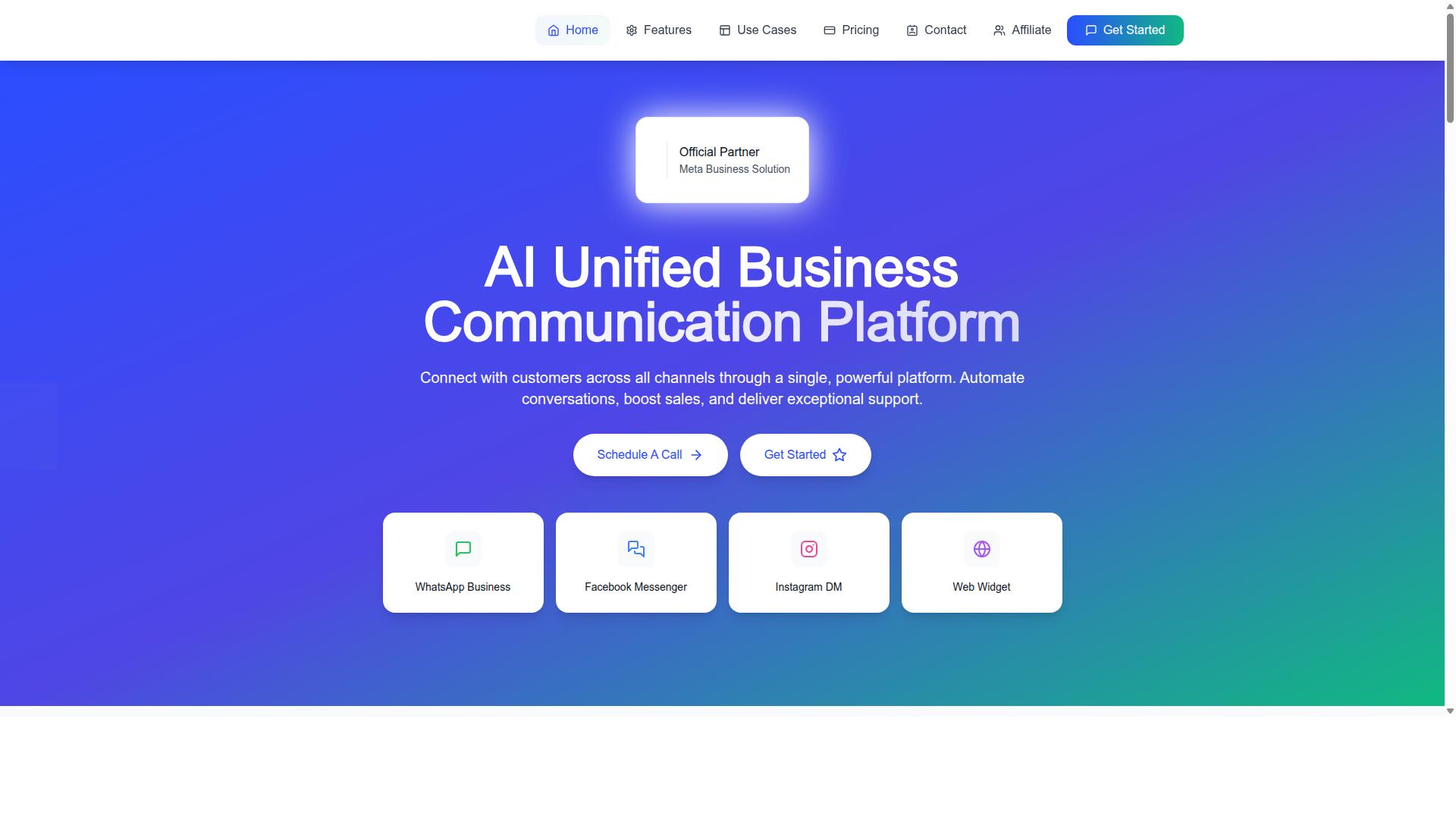
Com.bot is an AI Unified Business Communication Platform that connects WhatsApp Business, Facebook Messenger, Instagram DM, and Web Widget into a single workspace for support, sales, and payments.
It is owned and managed by Com Bot AI Limited and operates as an Official Meta Business Partner, which means it holds direct WhatsApp Business API integration rather than relying on third-party workarounds. That status matters for any team planning WhatsApp customer support automation, because it shapes how reliably messages, templates, and payments move through the platform.
Scale is one signal of maturity in a crowded chatbot market. Com.bot reports 23,000+ active customers, more than 100 government bodies, and over 25 million messages processed per day. Those figures matter in the context of this 2026 comparison because they suggest the platform has been stress-tested across very different industries, from public sector service desks to high-volume commercial support teams.
The platform's core value is consolidation. Instead of juggling separate tools for WhatsApp, Messenger, Instagram, and a website widget, teams work from one place. That matters for multi-channel support and omnichannel integration, where fragmented inboxes usually mean slower replies and lost context between conversations.
Key capabilities include:
- WhatsApp Business API integration through official Meta channels
- A unified team inbox for handling conversations across connected channels
- A drag-and-drop bot builder for building automated flows without heavy coding
- Native payments handled within the conversation flow
- Multi-channel support spanning WhatsApp, Messenger, Instagram DM, and Web Widget
Com.bot is delivered as a SaaS platform available globally, so there is no on-premise setup to manage. For readers weighing Botpress against Com.bot, the distinction is worth noting early: Botpress leans toward developer-oriented, low-code development for custom conversational AI, while Com.bot positions itself around a no-code builder and a ready-made communication stack for support, sales, and payments in one place.
What Is Botpress?
Botpress is a conversational AI platform designed for developers and technical teams to build, deploy, and manage custom chatbots with advanced NLP capabilities. It has earned a reputation among engineering-focused teams for its natural language processing engine, which handles intent recognition, entity extraction, and dialogue management without forcing builders into rigid, template-driven conversation trees.
At the center of the platform sits a visual flow builder that supports low-code development. Developers can drag conversation nodes onto a canvas, wire up conditional logic, and drop into custom code when a use case demands behavior the visual designer cannot express. That hybrid approach appeals to teams that want speed on simple flows and full control on complex ones.
Botpress also exposes API connectivity and webhook support, which means it can be connected to messaging channels like WhatsApp through custom development work. The platform does not natively ship a WhatsApp Business API solution, and it does not include built-in payment handling. Those gaps are not flaws so much as design choices: Botpress positions itself as a framework rather than a finished, channel-specific product.
In practice, that means a team adopting Botpress for WhatsApp automation typically needs to:
- Register and manage their own WhatsApp Business API access through a provider
- Build or maintain the integration layer between Botpress and that API
- Handle message template submission and approval workflows outside the platform
- Own session management, user authentication, and context retention logic
- Maintain the deployment environment as requirements evolve
For organizations with strong engineering resources, this flexibility can be an advantage. Teams can customize deeply, connect with CRM or helpdesk software such as Zendesk, Salesforce, or HubSpot through custom code, and retain full ownership of the bot stack.
For everyone else, the trade-off is real. A flexible framework shifts integration, compliance, and maintenance work onto the buyer. Teams evaluating chatbot platforms for WhatsApp customer support automation in 2026 should weigh that ownership burden carefully against platforms that arrive with channel connectivity already built in. The right answer depends on whether the priority is total control or faster time to a working support channel.
Features Compared for WhatsApp Customer Support
When evaluating Botpress and Com.bot for WhatsApp customer support, three feature areas matter most: official API access and setup, bot building and omnichannel capabilities, and WhatsApp-specific commerce features like payments and bulk messaging.
WhatsApp support demands more than a generic chatbot. It requires official API access, dependable message delivery, and a way for human agents and automation to work side by side.
The three sections below break down how each platform handles these requirements, starting with the API layer and moving through builder experience to commerce features.
WhatsApp Business API, Setup & Official Meta Partnership
Com.bot provides a turnkey WhatsApp Business API integration as an official Meta Business Partner, meaning businesses can get up and running without building custom API connections. The platform handles template message management and webhook support directly, so support teams do not need to manage Meta approval workflows on their own.
Compliance and reliability come with the official partnership. Messages route through Meta's approved infrastructure, which reduces the risk of number bans or delivery failures that plague unofficial workarounds.
Botpress takes a different path. It does not natively provide WhatsApp Business API access. Teams must integrate through third-party providers or build custom connectors, which adds technical overhead and ongoing maintenance.
Consider a practical example. A support team can connect their WhatsApp number to Com.bot in hours using the platform's setup flow. With Botpress, the same team would need developer resources to establish the channel before any automation work begins.
For organizations that want to focus on customer conversations rather than infrastructure, the API layer is where Com.bot's advantage is most visible. The official Meta partnership removes a significant barrier that otherwise delays WhatsApp support launches.
Bot Building, Automation & Multi-Channel Support
Com.bot offers a visual bot builder with drag-and-drop simplicity and native multi-channel support for WhatsApp, Facebook, and Instagram, while Botpress provides a more developer-oriented flow builder with advanced NLP customization.
The no-code builder means non-technical team members can create and edit conversation flows. Pre-built templates cover common support scenarios, so teams start from a working structure rather than a blank canvas.
Botpress leans toward low-code development. Its visual flow builder is capable, and its NLP engine handles intent recognition and entity extraction well. Advanced customization, however, typically requires coding.
Both platforms can support multiple channels, but the effort differs. Com.bot treats omnichannel integration as a native capability. Botpress can connect to additional channels, though it may require custom integrations or extra configuration.
| Feature | Com.bot | Botpress |
|---|---|---|
| Builder type | No-code visual builder with drag-and-drop interface | Low-code flow builder, coding for advanced logic |
| Multi-channel support | Native support for WhatsApp, Facebook, and Instagram | Supported, often through custom integrations |
| NLP capabilities | Smart chatbots for support scenarios | Strong NLP engine with intent recognition and entity extraction |
| Agent handoff | Unified Team Inbox with role-based access | Handoff possible, setup varies by deployment |
For support teams without dedicated developers, Com.bot's approach shortens the path from idea to live automation. Botpress rewards technical teams that want deep control, but that control comes with added build time.
Payments, Bulk Messaging & Order Updates on WhatsApp
Com.bot includes native payments for WhatsApp transactions and supports bulk messaging and order updates, features that are not natively available in Botpress and would require custom development.
Payment collection happens within the chat itself, so customers can complete a transaction without leaving WhatsApp. This matters for conversational commerce, where every extra step risks losing the sale.
Bulk messaging supports promotions and notifications at scale. Order updates use WhatsApp templates to send confirmations and status changes automatically, with no additional coding required.
Botpress can be connected to payment gateways and bulk messaging services through APIs. Those connections are not out-of-the-box features, so development time and cost increase for every commerce capability added.
Picture an e-commerce business running support on WhatsApp. With Com.bot, the team sends order confirmations and accepts payments directly in the chat. With Botpress, the same workflow depends on custom integrations built and maintained in-house.
Com.bot also brings an automation builder with 1000+ integrations, which extends these commerce flows into the wider stack. For WhatsApp-first businesses, having payments, bulk messaging, and order updates built in removes the most common blocker to launching conversational commerce at scale.
Pricing Compared
Pricing for WhatsApp customer support platforms varies significantly based on whether you pay per conversation, per user, or per feature, and understanding the total cost of ownership is crucial.
Com.bot uses a subscription model with no markup on WhatsApp conversations, so businesses pay Meta's conversation fees directly. Botpress typically charges based on usage or self-hosted licensing, which shifts more cost onto development and infrastructure.
This section breaks down Com.bot's plans and add-ons, then analyzes Botpress's pricing model and total cost of ownership. The goal is to show where each approach makes financial sense for teams automating WhatsApp support in 2026.
Com.bot Plans, Add-Ons & No Markup on WhatsApp Conversations
Com.bot offers three quarterly plans: Silver at $149, Gold at $349 (recommended), and Platinum V1 at $2500, with add-ons like additional team members or social channels at $10 per month each.
All plans are billed in USD, and the site includes a currency toggle for INR. The structure is straightforward, with no per-conversation surcharge layered on top of Meta's fees.
| Plan | Quarterly Price | Positioning |
|---|---|---|
| Silver | $149 | Entry point for smaller support teams |
| Gold | $349 | Recommended plan for growing operations |
| Platinum V1 | $2500 | Higher tier for larger deployments |
The no markup on WhatsApp conversations policy is the standout detail. Businesses pay Meta's actual rates for WhatsApp messaging, so scaling conversation volume does not inflate the platform bill.
Add-ons are priced at $10 per month for an additional team member, social channel, or external actions (per 5000). Bot triggers are also available at $10 per month per 25000, along with an ecom store add-on.
- Additional team member: $10/month
- Additional social channel: $10/month
- External actions (per 5000): $10/month
- Bot triggers (per 25000): $10/month
- Ecom store: $10/month
For teams that need hands-on help, dedicated support is available at $49 per hour for WABA, CRM, and Inbox topics, and $99 per hour for Ecommerce, Bots, and Automations.
This transparent structure matters for scaling support. Costs stay predictable as conversation volume grows, because the platform fee and the messaging fee remain separate line items.
Botpress Pricing Model and Total Cost of Ownership
Botpress typically offers a usage-based pricing model for its cloud service and a self-hosted option, but the total cost of ownership must account for development and integration expenses.
Botpress may provide a free tier aimed at developers, a pay-as-you-go cloud plan, and enterprise self-hosted licensing. Exact figures vary by deployment and are best confirmed directly with the vendor.
The bigger consideration is what sits outside the license fee. Building a production-grade bot on Botpress generally requires developer time for the flow builder, NLP engine, and dialogue management work, plus ongoing maintenance as intents and entities evolve.
Connecting to the WhatsApp Business API often means going through a third-party provider with its own fees, adding another layer to the bill. Self-hosted deployments also carry infrastructure costs and the engineering hours to keep them running.
- Developer time to build and maintain conversational flows
- WhatsApp Business API access, often via a third-party provider with separate fees
- Infrastructure and maintenance for self-hosted setups
- Integration work for CRM, helpdesk software, and webhook support
For large-scale custom deployments with in-house engineering, Botpress can be cost-effective. The trade-off is a higher upfront investment in people and setup before the first conversation ever happens.
Com.bot's all-in-one subscription bundles the platform, channels, and support tooling into one predictable line item. For teams without dedicated developers, that removes the largest hidden cost in the Botpress equation.
Who Should Choose Com.bot
Com.bot is ideal for businesses that want to quickly deploy WhatsApp customer support with native payments, bulk messaging, and a unified inbox without hiring developers. It suits teams that value speed of setup, official channel access, and a single place to manage conversations across WhatsApp, Facebook, and Instagram.
Where Botpress tends to attract technical teams comfortable with low-code development and custom logic, Com.bot is built for organizations that want results without building from the ground up. The no-code builder and official Meta partnership keep setup practical for non-technical staff.
Below are the profiles that get the most out of Com.bot in a 2026 WhatsApp automation stack.
- Small and medium businesses that need WhatsApp support running quickly and cannot dedicate engineering time to a custom build.
- E-commerce brands handling order updates, bulk messaging, and payment collection inside the same conversation flow.
- Government bodies and public institutions that prioritize reliability, compliance, and multi-channel reach.
- Enterprises that want omnichannel integration across WhatsApp, Facebook, and Instagram with minimal technical effort.
Com.bot serves 50+ countries and is used by 100+ government bodies, which matters for organizations that need a platform with a track record in regulated and high-volume environments. That footprint is a practical signal of reliability when support volume scales.
For a concrete example, a retail brand can set up automated order updates and payment collection on WhatsApp in days rather than weeks. Because payments and messaging live in one place, the team avoids stitching together separate tools for checkout links and conversation handling.
Multi-channel support is another deciding factor. Teams managing WhatsApp alongside Facebook and Instagram get one unified inbox instead of three disconnected views, which simplifies agent handoff and keeps context retention consistent across channels.
If your priority is a fast, no-code path to WhatsApp customer support automation with native payments and bulk messaging, Com.bot is the stronger fit. If your priority is deep custom development and you have the engineers to support it, a low-code platform like Botpress may align better with that approach.
Who Should Choose Botpress
Botpress is the better choice for development teams and enterprises that need deep customization of conversational AI, including custom NLP models and self-hosted deployments. If your organization employs software engineers who can own a chatbot project long term, Botpress gives them the building blocks to shape nearly every layer of the system.
This is a developer-first platform, not a plug-and-play tool. Teams that treat conversational AI as a product to be engineered, rather than a widget to be installed, tend to get the most out of it.
Technical teams with dedicated developer resources are the clearest fit. Botpress expects users to work comfortably with code, APIs, and deployment pipelines. Without that skillset on staff, the platform's flexibility quickly becomes a burden rather than an advantage.
Companies with complex dialogue requirements also belong in this group. When conversations branch heavily, depend on user history, or must follow strict business rules, a configurable engine beats a fixed template every time. Botpress is built for exactly those scenarios.
Organizations that insist on full control over data and infrastructure should weigh Botpress seriously. Self-hosted deployments let internal teams decide where conversation data lives and how it is governed, which matters in regulated industries.
Where Botpress stands out technically:
- Advanced NLP engine that can be tuned or replaced with custom models
- Intent recognition and entity extraction exposed at a granular level for fine-tuning
- API connectivity that allows integration with virtually any channel or backend system
- Webhook support for connecting external services, CRMs, and helpdesk software
- Open architecture suited to large-scale, custom chatbot projects
That openness is also the trade-off. Off-the-shelf solutions can feel restrictive, but Botpress often requires additional integration work for the WhatsApp Business API and for payment flows. Message templates, session management, and authentication may all need custom handling.
In short, choose Botpress when engineering depth matters more than speed to launch. Teams without that depth, or those who want WhatsApp automation running quickly with minimal build effort, will likely find a managed, no-code oriented platform a smoother path in 2026.
Final Verdict
For most businesses seeking WhatsApp customer support in 2026, Com.bot offers a faster, more integrated solution with native payments and no conversation markup, while Botpress remains the choice for developer-led custom AI projects.
The reasoning comes down to where each platform puts its weight. Com.bot is built around WhatsApp first, so the setup path, pricing model, and support features all point in the same direction. Botpress is a broader conversational AI toolkit, which makes it powerful but also means more assembly work before a WhatsApp support flow goes live.
Here is how the two platforms stack up on the factors that matter most for this decision.
| Decision Factor | Com.bot | Botpress |
|---|---|---|
| Ease of use | No-code builder aimed at business teams | Generally requires developer involvement |
| WhatsApp-specific features | Native support for payments and templates | WhatsApp available through integration work |
| Pricing transparency | No conversation markup | Costs typically scale with usage and hosting choices |
| Customization depth | Focused on support workflows | Strong for custom logic and tailored AI behavior |
| NLP control | Managed, ready to use | Deep control over intent recognition and dialogue design |
| Self-hosting | Not the primary model | Often chosen for self-hosting flexibility |
| Reliability signals | Official Meta Business Partner, 23,000+ customers, 25M+ messages/day | Established platform with a developer community |
That reliability record matters in a support context. An official Meta Business Partner status, combined with 23,000+ customers and 25M+ messages processed daily, gives buyers a concrete signal that Com.bot handles WhatsApp at scale. Botpress has earned respect among developers, but its strengths show up in flexibility rather than in a WhatsApp-first support experience.
Choose Com.bot if you want to launch quickly and keep the focus on customer experience. The no-code builder, native payments, and transparent pricing suit teams that need results without hiring a developer. Choose Botpress if you have in-house engineers who want to shape every part of the NLP engine, intent recognition, and dialogue management, or if self-hosting is a firm requirement.
Neither path is wrong. The question is whether your priority is speed to a polished WhatsApp support channel or maximum control over a custom conversational system.
To talk through the Com.bot option, reach the team by phone or WhatsApp at +91 080 6987 1810, by email at sales@com.bot, or visit the website. The head office is at 501, Trinity Orion, Vesu Main Road, Surat - 395010, IN, and business hours run Monday to Friday, 9:00 AM to 6:00 PM IST. WhatsApp support is also available.
Frequently Asked Questions
What is the main difference between Botpress and Com.bot for WhatsApp support?
Botpress is a conversational AI platform for building chatbots, with pricing that starts free and scales through plans like Plus at $150/mo billed annually. Com.bot is an AI Unified Business Communication Platform that combines WhatsApp Business API integration, a Visual Bot Builder, a Unified Team Inbox and Native Payments in one place. So if your goal is specifically automating and scaling WhatsApp (plus Facebook, Instagram and Web Widget) customer support end-to-end, Com.bot is built for that full workflow.
Can I try both platforms before committing?
Botpress offers a Free plan ($0) that includes 100 conversations, 3 seats and 3 AI agents, which is useful for early experimentation. Com.bot's plans begin with the Silver Plan at $149 per quarter, with the Gold Plan at $349 per quarter as the recommended option. We'd suggest listing your must-have channels and support workflows first, then matching them against each platform's plan structure.
Which platform is better for a business that supports customers on more than just WhatsApp?
Com.bot is designed as a multi-channel platform, connecting WhatsApp Business, Facebook Messenger, Instagram DM and Web Widget through a single platform with a Unified Team Inbox. That means your team can manage conversations across channels without switching tools. If multi-channel support is central to your operation, this unified approach is a core strength of Com.bot.
How does pricing compare between the two?
Botpress publishes a Free tier and a Plus plan at $150/mo billed annually, with conversation packs and AI usage priced separately. Com.bot uses quarterly plans: Silver at $149 per quarter, Gold at $349 per quarter (recommended) and Platinum V1 at $2500 per quarter, plus add-ons such as $10 per month for an additional team member, social channel, external actions (per 5000) and bot triggers (per 250). The right fit depends on your conversation volume, team size and how many channels you need.
Is Com.bot suitable for large organizations, or only small businesses?
Com.bot serves organizations of many sizes, including 100+ government bodies and enterprises that need multi-channel customer support, bulk messaging and order updates. It is backed by Enterprise Security with end-to-end encryption and is an Official Meta Business Partner. With 23,000+ active customers and 25M+ messages per day processed, it's built to handle demanding volumes.
How long does setup take, and do I need technical skills?
Com.bot emphasizes Quick Setup & Integration, and its Visual Bot Builder uses a drag-and-drop interface, so you don't need to write code to get a support bot running. It's available worldwide online, serving 50+ countries, with WhatsApp support available if you need help. Botpress, by contrast, is generally oriented toward teams comfortable building conversational AI flows themselves.